
Singapore Holds Nearly Twice as Much Inbound Direct Investment as It Sends Back Out. The Geography of the Gap Marks a Capital Re-Exporter.
July 5, 2026
If Southeast Asia’s Greenfield FDI Announcements Hit a Record, Why Did Its Balance-of-Payments Inflows Fall?
July 5, 2026
Founder Notes — Lotus Investment Group
Vốn đầu tư trực tiếp nước ngoài chảy vào hệ thống thực phẩm của khu vực gần như trọn vẹn ở khâu hạ nguồn
Foreign direct investment enters the region’s food system overwhelmingly downstream
Chúng tôi xem xét vốn đầu tư trực tiếp nước ngoài đi vào đâu trong nền kinh tế thực phẩm của Đông Nam Á, và thấy nó gần như dồn hết về hạ nguồn, vào các nhà máy chế biến và dây chuyền đồ uống, chỉ chạm tới khâu trồng trọt chăn nuôi ở phần rìa. Độ nghiêng này không phải nét riêng của khu vực mà là hình hài địa phương của một quy luật toàn cầu. Trên thế giới, ngành chế biến thực phẩm, đồ uống và thuốc lá hút khoảng 5,6% tổng FDI, so với 0,4% cho nông nghiệp kể cả lâm nghiệp và thủy sản, một khoảng cách chừng mười bốn trên một (FAO, “Trends and impacts of foreign investment in developing country agriculture”). Cùng cái nêm ấy hiện ra trong sổ sách đầu tư quốc gia của những nước tiếp nhận lớn nhất khu vực. Tại Indonesia, vốn nước ngoài vào ngành chế biến thực phẩm năm 2023 gấp khoảng năm lần FDI vào toàn bộ khu vực nông nghiệp. Khu vực nông nghiệp của Việt Nam xấp xỉ một phần tám sản lượng nhưng hoàn toàn không có tên trong nhóm ngành nhận FDI lớn nhất. Dòng vốn đi theo phần của chuỗi thực phẩm mà một doanh nghiệp nước ngoài có thể sở hữu và vận hành trên một biên lợi nhuận ràng buộc được bằng hợp đồng, rồi bỏ qua phần mà nó không thể.
Chúng tôi xem xét vốn đầu tư trực tiếp nước ngoài đi vào đâu trong nền kinh tế thực phẩm của Đông Nam Á và thấy nó dồn gần như trọn vẹn về hạ nguồn, ở chế biến và đồ uống, còn khâu trồng trọt chăn nuôi chỉ được chạm tới ở phần rìa.
Khuôn mẫu này là hình hài địa phương của một quy luật toàn cầu. Trên thế giới, ngành chế biến thực phẩm, đồ uống và thuốc lá hút khoảng 5,6% FDI so với chừng 0,4% cho nông nghiệp kể cả lâm nghiệp và thủy sản (FAO), và trong bản thân FDI nông nghiệp-thực phẩm, sản xuất sơ cấp chiếm chưa tới 10%.
Indonesia bày ra vết tách đôi ngay bên trong một nền kinh tế — FDI chế biến thực phẩm khoảng 2,26 tỷ USD năm 2023 so với chừng 441 triệu USD cho toàn bộ nông nghiệp, trong đó cây công nghiệp lâu năm chiếm 94,47% và cây lương thực 0,57% (2018–2022).
Khuôn mẫu toàn cầu: tiền chảy vào nhà máy, không vào cánh đồng
Điểm khởi đầu là con số của cả thế giới, bởi mọi nền kinh tế tiếp nhận trong khu vực đều thừa hưởng cùng một cấu trúc động lực. FAO, khi tổng hợp dữ liệu UNCTAD, đặt FDI vào nông nghiệp, kể cả săn bắn, lâm nghiệp và thủy sản, ở mức 0,4% tổng FDI toàn cầu, và FDI vào thực phẩm, đồ uống và thuốc lá ở mức 5,6%. Nông nghiệp-thực phẩm gộp lại chưa tới 5% dòng vốn FDI chảy về các nước đang phát triển. Hoạt động nuôi sống con người chỉ là một sai số làm tròn trong cuốn sổ ghi lại nơi dòng vốn xuyên biên giới tìm đến.
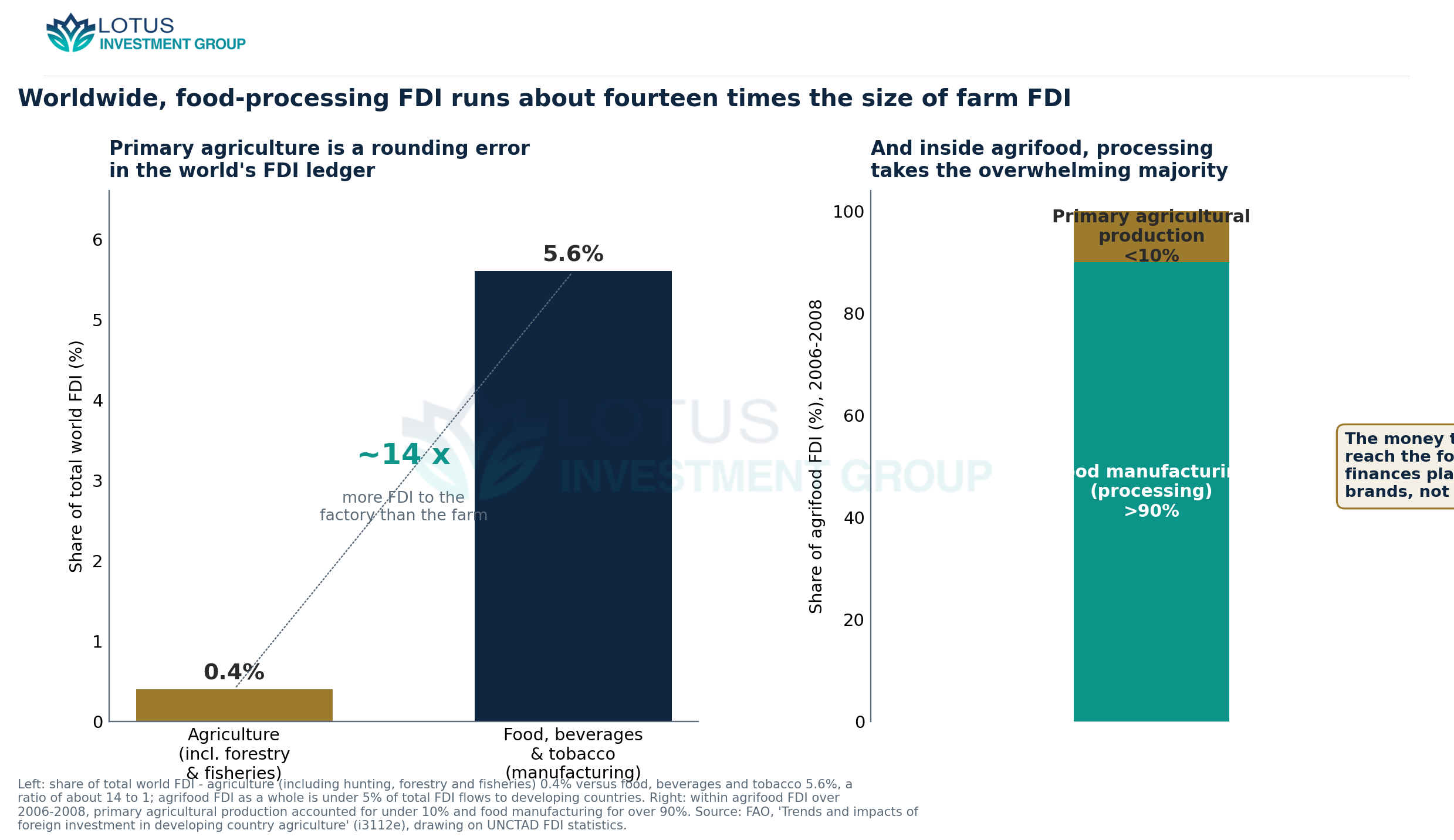
Thành phần bên trong nông nghiệp-thực phẩm càng làm rõ điểm này. Giai đoạn 2006 đến 2008, sản xuất nông nghiệp sơ cấp chiếm chưa tới 10% FDI nông nghiệp-thực phẩm, phần còn lại thuộc về chế biến thực phẩm. Lý do mang tính cấu trúc chứ không theo chu kỳ. Một nhà máy chế biến là tài sản mà nhà đầu tư nước ngoài có thể sở hữu trọn vẹn, vận hành trên một biên lợi nhuận ràng buộc được bằng hợp đồng nằm giữa đầu vào tại cổng trại và sản phẩm gắn thương hiệu, rồi mở rộng từng nhà máy một. Một cánh đồng thì không. Lợi suất của nó phụ thuộc vào thời tiết và một lớp nông hộ nhỏ mà nhà đầu tư không kiểm soát, và ở hầu hết khu vực người nước ngoài không thể đứng tên sở hữu. Vì thế túi vốn nông nghiệp-thực phẩm sâu nhất, xét về cấu trúc, chỉ nhắm vào một đầu của chuỗi.
Indonesia cho thấy vết tách đôi ngay bên trong một nền kinh tế
Không nước tiếp nhận nào phô bày cơ chế này gọn gàng hơn Indonesia ngay trong cùng một bộ sổ sách, nơi cơ quan đầu tư nhà nước báo cáo ngành công nghiệp thực phẩm và khu vực nông nghiệp thành hai dòng riêng.
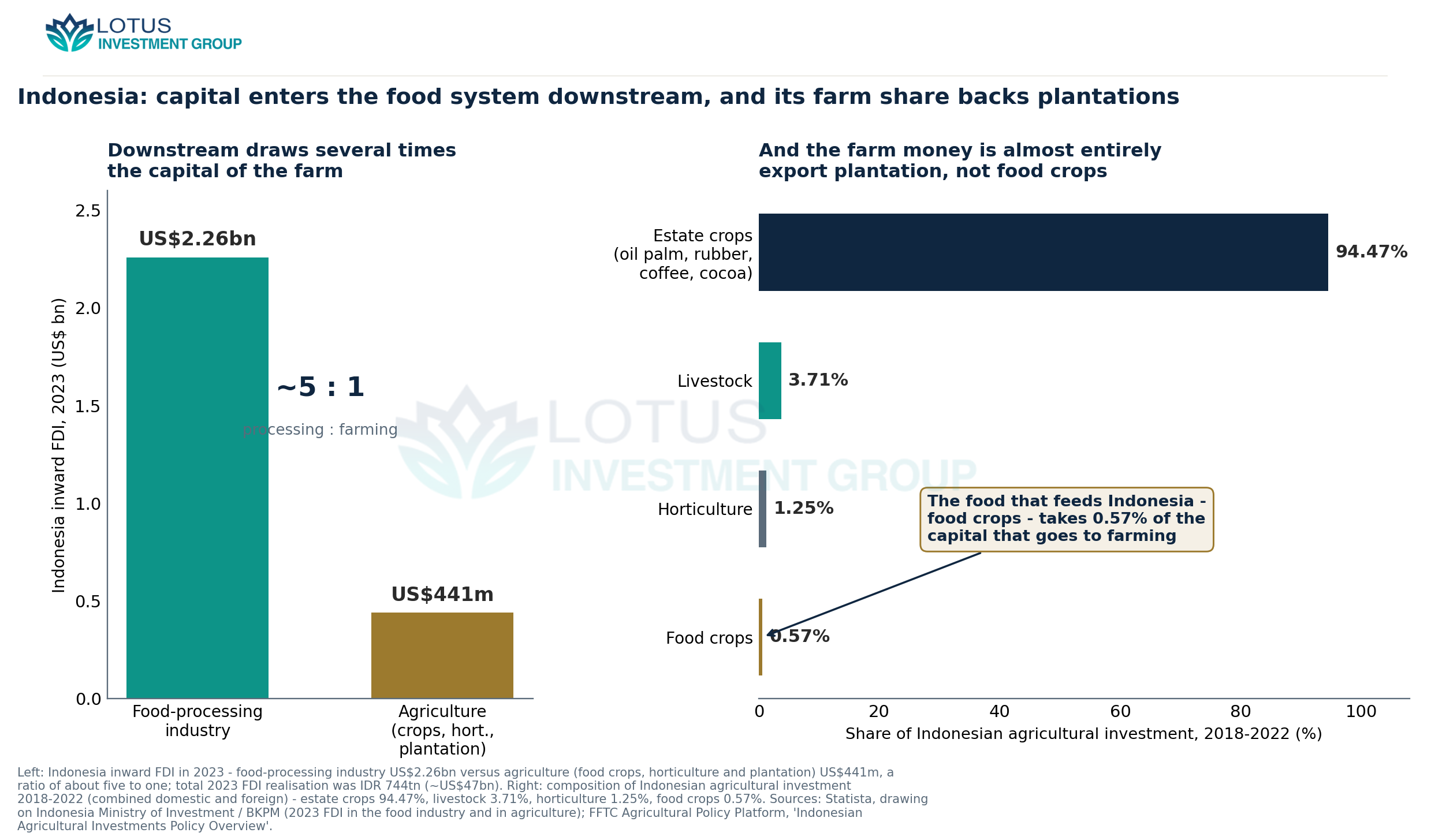
Vốn đầu tư trực tiếp nước ngoài vào ngành chế biến thực phẩm của Indonesia đạt khoảng 2,26 tỷ USD năm 2023, so với chừng 441 triệu USD cho nông nghiệp theo nghĩa hẹp, tức cây lương thực, rau quả và cây công nghiệp lâu năm cộng lại (Statista, dựa trên số liệu Bộ Đầu tư Indonesia). Chế biến kéo về gần năm đô la cho mỗi một đô la chạm tới trang trại, trên tổng vốn FDI thực hiện năm 2023 là 744 nghìn tỷ IDR, gần 47 tỷ USD. Khoảng cách năm trên một ấy chính là tỷ lệ mười bốn trên một của thế giới bị nén lại bởi nền tảng cây công nghiệp lâu năm lớn bất thường của Indonesia, vốn kéo con số của trang trại lên cao.
Bảng thứ hai là nơi phát hiện đổi chiều. Số vốn chạm được tới trang trại không chảy vào những loại cây nuôi sống người Indonesia. Suốt giai đoạn 2018 đến 2022, cây công nghiệp lâu năm như cọ dầu, cao su, cà phê và ca cao nhận 94,47% vốn đầu tư nông nghiệp, chăn nuôi 3,71%, rau quả 1,25%, còn cây lương thực 0,57% (FFTC Agricultural Policy Platform). Vốn nước ngoài trong khung thời gian này tăng nhanh hơn vốn trong nước, gần 26% mỗi năm, nhưng nó tăng trên dòng cây công nghiệp lâu năm. Nửa phần trăm chạm tới cây lương thực là câu nói sắc nhất trong dữ liệu. Ngay cả khi vốn đi vào cánh đồng thay vì nhà máy, nó chống lưng cho một loại cây hàng hóa xuất khẩu, không phải hạt gạo và lương thực thiết yếu trên mâm cơm nội địa.
Đường ống ưu đãi của Thái Lan nghiêng theo cùng một hướng
Thái Lan ghi nhận dòng vốn ở điểm ý định thay vì thực hiện, thông qua các đơn xin ưu đãi mà Ủy ban Đầu tư (BOI) phê duyệt, và ý định ấy cũng chỉ về hạ nguồn.
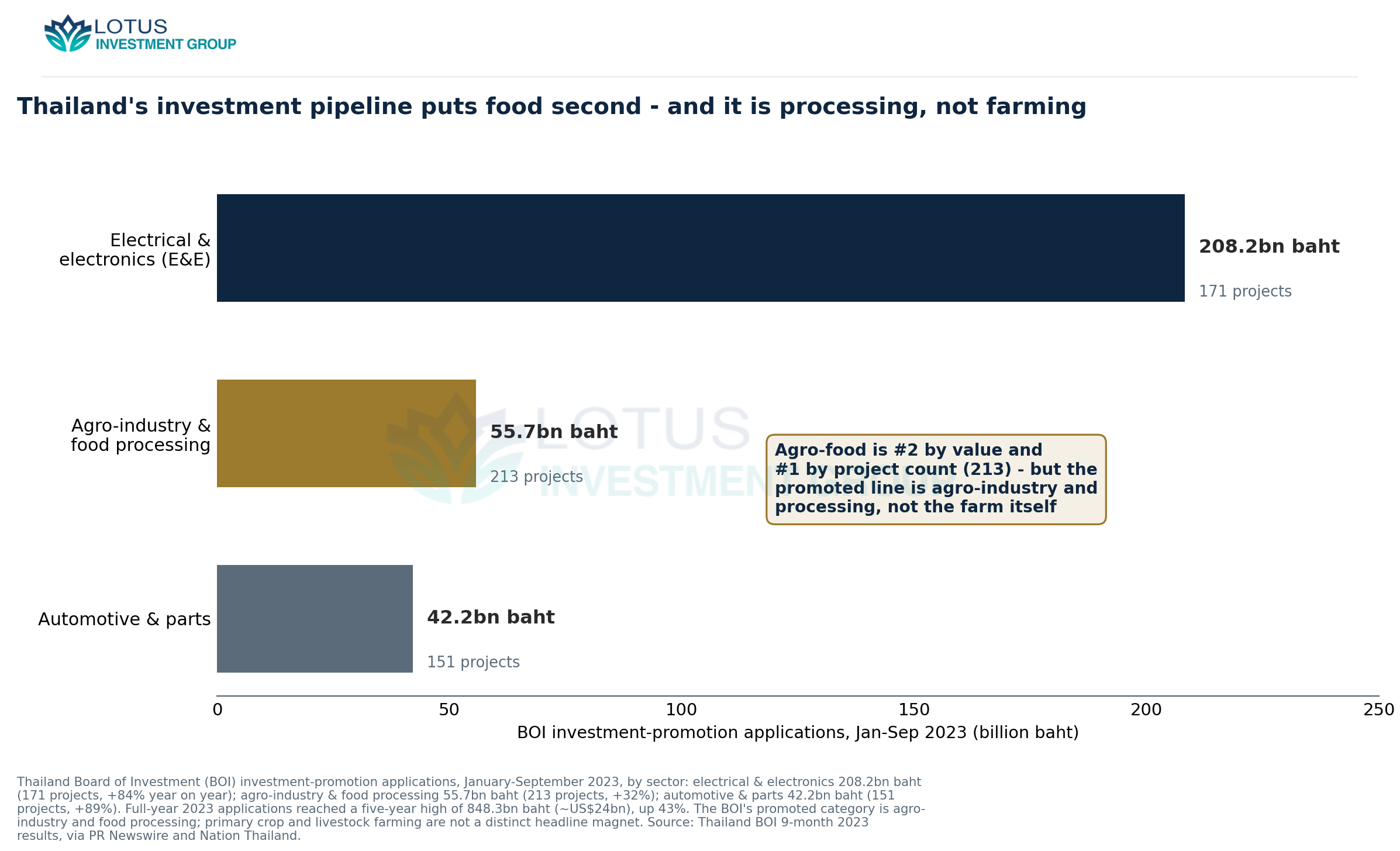
Trong chín tháng đầu năm 2023, công nghiệp nông sản và chế biến thực phẩm là ngành lớn thứ hai xét theo giá trị đăng ký, đạt 55,7 tỷ baht qua 213 dự án, tăng 32% so với cùng kỳ, đứng sau điện và điện tử với 208,2 tỷ baht và trên ô tô và phụ tùng với 42,2 tỷ baht (BOI Thái Lan, kết quả chín tháng 2023). Trên thực tế đây là ngành lớn nhất xét theo số lượng dự án. Đơn xin ưu đãi cả năm 2023 đạt mức cao nhất năm năm, khoảng 848,3 tỷ baht, gần 24 tỷ USD, tăng 43%. Thực phẩm rõ ràng là một thỏi nam châm thực sự hút vốn ở Thái Lan, mạnh hơn hầu hết các nước tiếp nhận khác. Nhưng hạng mục được ưu đãi là công nghiệp nông sản và chế biến thực phẩm. Trồng trọt và chăn nuôi sơ cấp không phải một dòng nổi bật riêng. Đất nước tự gọi mình là gian bếp của châu Á kéo vốn đầu tư ngành thực phẩm về gian bếp, không về thửa ruộng.
Việt Nam làm nông gần như không có vốn ngoại
Việt Nam là trường hợp giới hạn, nơi khu vực nông nghiệp vừa lớn về kinh tế vừa vắng mặt đáng kể trong sổ sách FDI cùng một lúc.
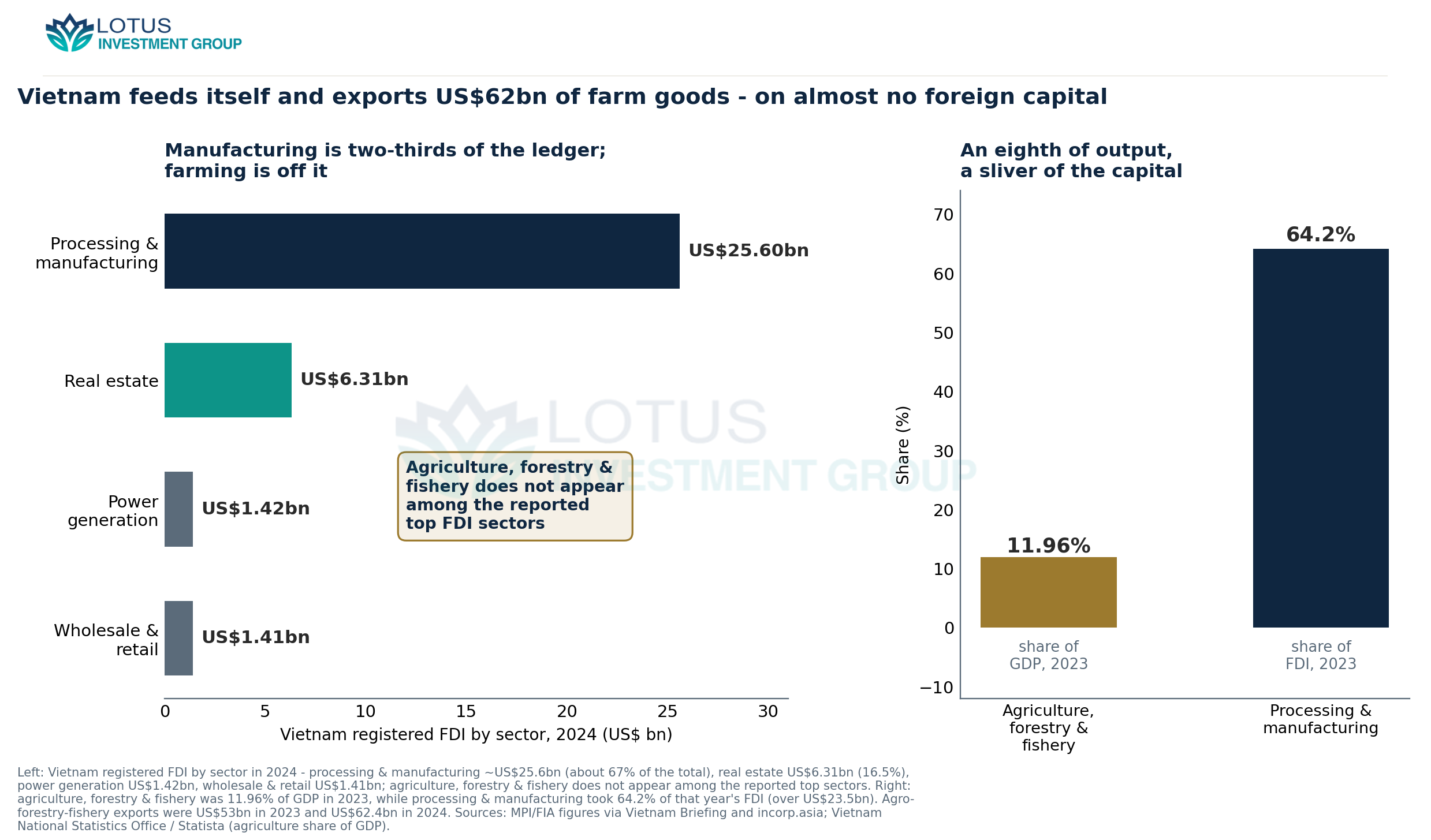
Chế biến và chế tạo nhận 64,2% vốn FDI đăng ký của Việt Nam năm 2023, trên 23,5 tỷ USD, và khoảng 25,6 tỷ USD, gần 67%, năm 2024 (số liệu Bộ Kế hoạch và Đầu tư và Cục Đầu tư nước ngoài, qua Vietnam Briefing và incorp.asia). Các ngành xếp sau là bất động sản với 6,31 tỷ USD, sản xuất điện với 1,42 tỷ USD và bán buôn bán lẻ với 1,41 tỷ USD. Khu vực nông nghiệp không xuất hiện trong nhóm nhận FDI lớn nhất được báo cáo ở cả hai năm. Đặt điều đó cạnh nền kinh tế thực. Nông-lâm-thủy sản chiếm 11,96% GDP năm 2023 và xuất khẩu 53 tỷ USD trong năm đó, tăng lên 62,4 tỷ USD năm 2024 (Tổng cục Thống kê Việt Nam). Một nhánh xấp xỉ một phần tám sản lượng và là một trong những nguồn thu xuất khẩu lớn nhất nước lại được tài trợ gần như không có vốn cổ phần nước ngoài. Và phần chế biến thực phẩm mà Việt Nam thu hút được nằm lẫn trong rổ chế tạo, cạnh điện tử và dệt may, nên ngay cả FDI nông nghiệp-thực phẩm của Việt Nam cũng là một câu chuyện hạ nguồn. Bản thân các trang trại vận hành bằng vốn trong nước và vốn hộ gia đình.
Vì sao dòng vốn đáp xuống hạ nguồn
Phát hiện này hẹp nhưng đứng vững qua bốn thước đo độc lập, từ một bản tổng hợp toàn cầu tới hai chuỗi vốn thực hiện quốc gia rồi một đường ống ưu đãi. Vốn đầu tư trực tiếp nước ngoài tài trợ hệ thống thực phẩm của khu vực ở nơi lợi suất ràng buộc được bằng hợp đồng và tài sản có thể do nước ngoài sở hữu, tức khâu chế biến, rồi phần lớn né phần của chuỗi nơi cả hai điều kiện đều không thỏa, tức trang trại. Ba ràng buộc gánh gần hết phần việc. Thứ nhất là đất đai, bởi hầu hết các nền kinh tế trong khu vực hạn chế hoặc cấm người nước ngoài sở hữu đất nông nghiệp, nên nhà đầu tư ngoại có thể dựng một nhà máy bên rìa thửa ruộng mà họ không bao giờ nắm giữ được. Thứ hai là manh mún ruộng đất, vì một dây chuyền chế biến ký hợp đồng với một đối tác trong khi một cơ sở trồng trọt phải gom hàng nghìn nông hộ nhỏ. Thứ ba là khả năng ràng buộc bằng hợp đồng, khi một nhà máy kiếm được biên lợi nhuận nhà đầu tư mô hình hóa được còn một vụ mùa kiếm được cái giá do thời tiết và thị trường định đoạt.
Với một chính phủ tiếp nhận, điều này có nghĩa cái đòn bẩy kéo FDI vào nền kinh tế thực phẩm, một ưu đãi nhắm vào nhà máy, không có phiên bản tự nhiên tương đương nhắm vào cánh đồng, nên khu vực nông nghiệp bị bỏ lại cho vốn trong nước và vốn công dù trọng lượng của nó trong sản lượng hay xuất khẩu có lớn đến đâu. Với nhà đầu tư, cách đọc là mức phơi nhiễm nông nghiệp-thực phẩm trong khu vực, trên thực tế, chính là phơi nhiễm với khâu chế biến, và một luận điểm ở tầng trang trại sẽ đâm vào bức tường sở hữu và gom tụ trước khi chạm được tới lợi suất. Nửa phần trăm dành cho cây lương thực ở Indonesia cho thấy ngay cả ngoại lệ đồn điền cũng ngả về cây hàng hóa xuất khẩu chứ không về lương thực thiết yếu nội địa. Vốn đã chảy vào nhà máy, và phần lớn ở lại đó.
Dữ liệu và giới hạn. Các tỷ trọng toàn cầu 0,4% và 5,6% cùng ngưỡng sản xuất sơ cấp dưới 10% là số liệu FAO tổng hợp từ dữ liệu UNCTAD cho giai đoạn giữa đến cuối những năm 2000, không phải một thước đo của năm hiện hành, và được dùng ở đây để xác lập khuôn mẫu cấu trúc chứ không phải một mức của năm 2023; UNCTAD có ghi nhận riêng rằng phần tham gia của nước ngoài vào nông nghiệp đã tăng kể từ đó, đáng chú ý là các dòng vốn Nam-Nam. Con số 2,26 tỷ USD ngành thực phẩm và 441 triệu USD nông nghiệp của Indonesia là FDI thực hiện năm 2023 do Bộ Đầu tư báo cáo qua Statista; tỷ lệ phân chia tiểu ngành 94,47% so với 0,57% là vốn đầu tư trong nước và nước ngoài gộp lại cho giai đoạn 2018 đến 2022 từ FFTC, nên nó không chỉ riêng FDI và bao trùm một khung thời gian khác. Số liệu của Thái Lan là đơn xin ưu đãi đầu tư của BOI, tức vốn cam kết chứ không phải vốn thực hiện, và lát cắt ngành theo chín tháng là mức chi tiết nhất được công bố; công nghiệp nông sản và chế biến thực phẩm là một hạng mục gộp của BOI. Các tỷ trọng ngành của Việt Nam là số vốn đăng ký của Bộ Kế hoạch và Đầu tư/Cục Đầu tư nước ngoài được báo cáo qua các kênh theo dõi thứ cấp; việc nông nghiệp vắng mặt khỏi danh sách ngành dẫn đầu mang tính gợi mở nhưng không phải một con số không được công bố, và chế biến thực phẩm không được tách riêng khỏi chế tạo. Các phép quy đổi tiền tệ là gần đúng. Ở đâu một con số không thể truy về nguồn sơ cấp hay một bản công bố thứ cấp có ghi nguồn rõ ràng, con số đó không được sử dụng.
We examine where foreign direct investment enters Southeast Asia’s food economy and find that it lands almost entirely downstream, in processing plants and beverage lines, and reaches primary farming only at the margin. The tilt is not a regional quirk but the local form of a global rule. Worldwide, food, beverage and tobacco manufacturing draws about 5.6 percent of all FDI against 0.4 percent for agriculture including forestry and fisheries, a gap of roughly fourteen to one (FAO, “Trends and impacts of foreign investment in developing country agriculture”). The same wedge shows up in the national investment ledgers of the region’s largest hosts. In Indonesia, foreign capital in the food-processing industry ran about five times the FDI in all of farming in 2023. Vietnam’s farm sector is close to an eighth of output yet does not register among the top FDI-receiving sectors at all. Capital follows the part of the food chain a foreign firm can own and run at a contractible margin, and skips the part it cannot.
We examine where foreign direct investment enters Southeast Asia’s food economy and find it concentrated almost entirely downstream, in processing and beverages, with primary farming reached only at the margin.
The pattern is the local form of a global rule: worldwide, food, beverage and tobacco manufacturing draws ~5.6% of FDI against ~0.4% for agriculture including forestry and fisheries (FAO), and within agrifood FDI, primary production is under 10%.
Indonesia shows the split inside one economy – food-processing FDI ~US$2.26bn in 2023 against ~US$441m for all of agriculture, of which estate crops took 94.47% and food crops 0.57% (2018-2022).
The global template: the money goes to the factory, not the field
The starting point is the world figure, because every host economy in the region inherits the same incentive structure. FAO, compiling UNCTAD data, put FDI into agriculture, including hunting, forestry and fisheries, at 0.4 percent of total world FDI, and FDI into food, beverages and tobacco at 5.6 percent. Agrifood as a whole is under 5 percent of the FDI flowing to developing countries. The activity that feeds people is a rounding error in the ledger that records where cross-border capital goes.
The composition inside agrifood sharpens the point. Over 2006 to 2008, primary agricultural production accounted for under 10 percent of agrifood FDI and food manufacturing for the rest. The reason is structural rather than cyclical. A processing plant is an asset a foreign investor can own outright, run on a contractible margin between farm-gate input and branded output, and expand plant by plant. A field is not. Its return depends on the weather and a smallholder base the investor does not control, and in most of the region a foreigner cannot hold the title to it. So the deepest pool of agrifood capital is aimed structurally at one end of the chain.
Indonesia shows the split inside one economy
No host demonstrates the mechanism inside a single set of accounts more cleanly than Indonesia, where the state investment agency reports the food industry and farming as separate lines.
Foreign direct investment into Indonesia’s food-processing industry reached about US$2.26 billion in 2023, against roughly US$441 million for agriculture proper, meaning food crops, horticulture and plantation together (Statista, drawing on Indonesia’s Ministry of Investment). Processing drew close to five dollars for every one that reached the farm, out of total 2023 FDI realisation of IDR 744 trillion, near US$47 billion. That five-to-one gap is the fourteen-to-one world ratio compressed by Indonesia’s unusually large plantation base, which pulls the farm figure up.
The second panel is where the finding turns. The farm money that does arrive is not going into the crops that feed Indonesia. Across 2018 to 2022, estate crops such as oil palm, rubber, coffee and cocoa took 94.47 percent of agricultural investment, livestock 3.71 percent, horticulture 1.25 percent, and food crops 0.57 percent (FFTC Agricultural Policy Platform). Foreign capital in this window grew faster than domestic, near 26 percent a year, but it grew on the plantation line. The half a percent that reaches food crops is the sharpest statement in the data. Even where capital enters the field rather than the factory, it backs an export cash crop, not the rice and staples on the domestic table.
Thailand’s promotion pipeline tilts the same way
Thailand records the flow at the point of intent rather than realisation, through the applications its Board of Investment approves for promotion, and the intent points downstream too.
In the first nine months of 2023, agro-industry and food processing was the second-largest sector by pledged value, at 55.7 billion baht across 213 projects, up 32 percent on the year, behind electrical and electronics at 208.2 billion baht and ahead of automotive and parts at 42.2 billion baht (Thailand BOI, nine-month 2023 results). It was in fact the largest sector by project count. Full-year 2023 applications reached a five-year high of about 848.3 billion baht, near US$24 billion, up 43 percent. Food is plainly a real magnet for capital in Thailand, more so than in most hosts. But the promoted category is agro-industry and food processing. Primary crop and livestock farming is not a headline line of its own. The country that calls itself the kitchen of Asia draws its food-sector investment into the kitchen, not the paddy.
Vietnam farms on almost no foreign capital
Vietnam is the limiting case, where the farm sector is economically large and materially absent from the FDI accounts at the same time.
Processing and manufacturing took 64.2 percent of Vietnam’s registered FDI in 2023, over US$23.5 billion, and about US$25.6 billion, near 67 percent, in 2024 (MPI and Foreign Investment Agency figures, via Vietnam Briefing and incorp.asia). The next sectors down were real estate at US$6.31 billion, power generation at US$1.42 billion and wholesale and retail at US$1.41 billion. The farm sector does not appear among the reported top FDI recipients in either year. Set that against the real economy. Agro-forestry-fishery was 11.96 percent of GDP in 2023 and shipped US$53 billion of exports that year, rising to US$62.4 billion in 2024 (Vietnam National Statistics Office). A branch that is close to an eighth of output and one of the country’s largest export earners is financed almost without foreign equity. And the food processing that Vietnam does attract sits inside the manufacturing bucket, alongside electronics and textiles, so even its agrifood FDI is a downstream story. The farms themselves run on domestic and household capital.
Why the capital lands downstream
The finding is narrow and it holds across four independent measures, from a global compilation to two national realisation series to one promotion pipeline. Foreign direct investment finances the region’s food system where the return can be made contractible and the asset can be foreign-owned, which is processing, and it largely declines the part of the chain where neither condition holds, which is the farm. Three constraints do most of the work. Land is the first, since most economies in the region restrict or forbid foreign ownership of agricultural land, so a foreign investor can build a factory on the edge of a field it can never hold. Fragmentation is the second, because a processing line contracts with one counterparty while a farming operation must aggregate thousands of smallholders. Contractibility is the third, as a plant earns a margin an investor can model while a crop earns a price the weather and the market set.
For a host government, this means the lever that pulls FDI into a food economy, an incentive aimed at a plant, has no natural equivalent aimed at the field, and the farm sector is left to domestic and public capital whatever its weight in output or exports. For an investor, the read is that agrifood exposure in the region is, in practice, processing exposure, and that a farm-level thesis runs into the ownership and aggregation walls before it reaches the return. Indonesia’s half a percent to food crops shows even the plantation exception bends toward export cash crops rather than domestic staples. The capital went to the factory, and mostly stayed there.
Data and limits. The global 0.4 and 5.6 percent shares and the under-10-percent primary split are FAO figures compiled from UNCTAD data for the mid-to-late 2000s, not a current-year measure, and are used here to establish the structural pattern rather than a 2023 level; UNCTAD has separately noted foreign participation in agriculture rising since, notably South-South flows. Indonesia’s US$2.26 billion food-industry and US$441 million agriculture figures are 2023 FDI realisation reported by the Ministry of Investment via Statista; the 94.47-to-0.57 percent sub-sector split is combined domestic and foreign investment for 2018 to 2022 from FFTC, so it is not FDI-only and covers a different window. Thailand’s figures are BOI investment-promotion applications, which are pledged not realised capital, and the nine-month sectoral cut is the most granular published; agro-industry and food processing is a combined BOI category. Vietnam’s sector shares are MPI/FIA registered-capital figures reported through secondary trackers; agriculture’s absence from the top-sector list is informative but is not a published zero, and food processing is not separately broken out from manufacturing. Currency conversions are approximate. Where a figure could not be traced to a primary source or a clearly attributed secondary release, it is not used.

About the Author
Lưu Trọng An Hà (Harvey Luu Trong) là Người sáng lập Lotus Investment Group, một công ty tư vấn M&A và đầu tư có trụ sở tại TP.HCM, tập trung vào hành lang Việt Nam – Úc – ASEAN.
Harvey Luu Trong is the Founder of Lotus Investment Group, an M&A and investment advisory firm based in Ho Chi Minh City, focused on the Vietnam–Australia–ASEAN corridor.
References
[1]
FAO, ‘Trends and impacts of foreign investment in developing country agriculture’ (i3112e), drawing on UNCTAD FDI data. — FDI into agriculture (including hunting, forestry and fisheries) was about 0.4% of total world FDI while food, www.fao.org/4/i3112e/i3112e.pdf
[2]
Statista, ‘Indonesia: foreign direct investment in food industry 2023’, drawing on Indonesia’s Ministry of Investment / BKPM. — Foreign direct investment in Indonesia’s food industry (food processing) reached approximately US$2.26 billion www.statista.com/statistics/1401615/indonesia-foreign-direct-investment-in-food-industry/
[3]
Statista, ‘Indonesia: foreign direct investment in agriculture 2023’, drawing on Indonesia’s Ministry of Investment / BKPM. — FDI in Indonesia’s broader agriculture (food crops, horticulture and plantations) amounted to about US$441 mil www.statista.com/statistics/680189/foreign-direct-investment-agriculture-indonesia/
[4]
ANTARA News, ‘Investment realization of Rp1,418.9 trillion in 2023 surpassed target’ (BKPM). — Indonesia’s total 2023 investment realisation was IDR 1,418.9 trillion, of which foreign investment was IDR 74 en.antaranews.com/news/303858/investment-realization-of-rp14189-trillion-in-2023-surpassed-target
[5]
FFTC Agricultural Policy Platform, ‘Indonesian Agricultural Investments Policy Overview’. — Across 2018-2022, Indonesian agricultural investment (combined domestic and foreign) was concentrated in estat ap.fftc.org.tw/article/3535
[6]
Thailand Board of Investment (BOI), ‘Reports Steady Growth in 9-Month Results’, via PR Newswire. — In the first nine months of 2023, Thailand BOI investment-promotion applications in agro-industry & food proce www.prnewswire.com/apac/news-releases/thailand-board-of-investment-boi-reports-steady-growth-in-9-month-results-attracting-foreign-investment-and-fostering-key-industries-301983159.html
[7]
Thailand BOI, ‘Says 2023 Investment Applications up 43% to USD 24 Billion’, via PR Newswire. — Thailand BOI full-year 2023 investment-promotion applications reached a five-year high of 848.3 billion baht ( www.prnewswire.com/news-releases/thailand-boi-says-2023-investment-applications-up-43-to-usd-24-billion-as-large-fdi-projects-soar-302058865.html
[8]
MPI / Foreign Investment Agency figures reported via Vietnam Briefing and Statista (‘Vietnam: FDI inflows distribution by industry 2023’). — Vietnam’s processing and manufacturing sector led FDI in 2023 with over US$23.5 billion, about 64.2% of the to www.vietnam-briefing.com/news/vietnam-fdi.html/
[9]
MPI / Foreign Investment Agency figures via Vietnam Briefing, ‘Vietnam Economy in 2024: GDP, Trade, FDI’. — In 2024, Vietnam’s processing and manufacturing FDI was nearly US$25.6 billion (~67% of the total), real estat www.vietnam-briefing.com/news/vietnam-economy-2024-gdp-trade-fdi.html/
[10]
Vietnam National Statistics Office / Statista (GDP share); Vietnam Briefing (export values). — Agriculture, forestry and fishery was about 11.96% of Vietnam’s GDP in 2023; agro-forestry-fishery exports wer www.statista.com/statistics/1027971/vietnam-gdp-contribution-of-agriculture-forestry-and-fishing-sector/
[11]
UN Trade and Development (UNCTAD), ‘Foreign participation in agriculture is on the rise, notably South-South Foreign Direct Investment’. — Foreign participation in agriculture has been rising since the late 2000s, notably South-South FDI. unctad.org/press-material/foreign-participation-agriculture-rise-notably-south-south-foreign-direct-investment